Language is fuzzy and verbose
- Query terms: if a search query is made up of multiple terms, BM 25 will calculate a separate score for each term and then sum them up.
查询词:如果一个搜索查询由多个词组成,BM 25 会为每个词分别计算一个分数,然后将它们相加。 - Inverse Document Frequency (IDF): how rare is a given search term across the entire document collection? We assume that common words (such as “the” or “and”) are less informative than rare words. Therefore, we want to boost the importance of rare words.
逆文档频率(IDF):某个搜索词在整个文档集合中有多罕见?我们假设常见词(如“the”或“and”)的信息量不如罕见词。因此,我们希望提升罕见词的重要性。 - Term frequency in the document: how many times does a search term appear in a given document? We assume that more repetition of a query term in a given document increases the likelihood that that document is related to the term. However, BM 25 also adjusts this so that there are diminishing returns each time a term is repeated.
文档中的词频:某个搜索词在给定文档中出现了多少次?我们假设查询词在给定文档中重复得越多,该文档与该词相关的可能性就越大。然而,BM 25 也对此进行了调整,使得每次重复该词时收益递减。 - Document length: how long is the given document compared to others? Long documents might repeat the search term more, just by virtue of being longer. We don’t want to unfairly boost long documents, so BM 25 applies some normalization based on how the document’s length compares to the average.
文档长度:给定文档与其他文档相比有多长?长文档可能仅仅因为更长而更多地重复搜索词。我们不想不公平地提升长文档的权重,因此 BM 25 会根据文档长度与平均长度的比较应用某种归一化。
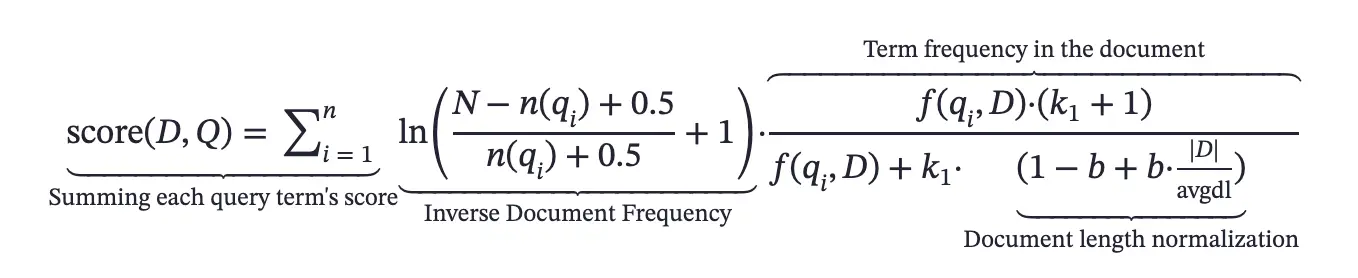
The constants 0.5 and 1 are there to smooth out the equation and ensure that we don’t end up with wildly varying results if the term is either very rare or very common.
常数 0.5 和 1 用于平滑方程,确保当词条非常罕见或非常常见时,我们不会得到差异过大的结果。
Links
- Similarity settings | Elasticsearch Reference
- Practical BM25 - Part 1: How Shards Affect Relevance Scoring in Elasticsearch | Elastic Blog
- Practical BM25 - Part 2: The BM25 Algorithm and its Variables | Elastic Blog
- Practical BM25 - Part 3: Considerations for Picking b and k1 in Elasticsearch | Elastic Blog
- TF-IDF
- Full Text Search
- Lucene
- Elasticsearch