What
A probabilistic data structure to count unique items.
Provides a very good approximation of the cardinality of a set even using a very small amount of memory. In the Redis implementation it only uses 12kbytes per key to count with a standard error of 0.81%, and there is no limit to the number of items you can count, unless you approach 2^64 items
How
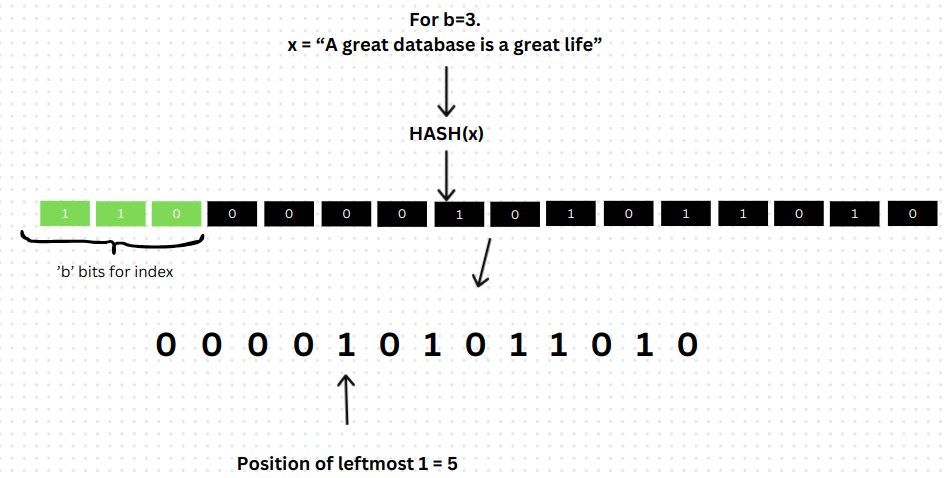
b: Number of initial bits in a binary representation of a hash valuem: Number of registers / buckets (= )p: MSB position of 1 (leftmost position)
- Hash a data, convert it to binary
- From the hashed value in binary form,
bbits are extracted from the MSB.- This is the index of register (in binary)
- Find the leftmost 1 from the remaining set of bits (MSB)
p =the number of leading zeros + 1
reg[b] = max(reg[b], p)-